

$1.4 Million in the San Fernando Valley: Porter Ranch vs. the South Valley
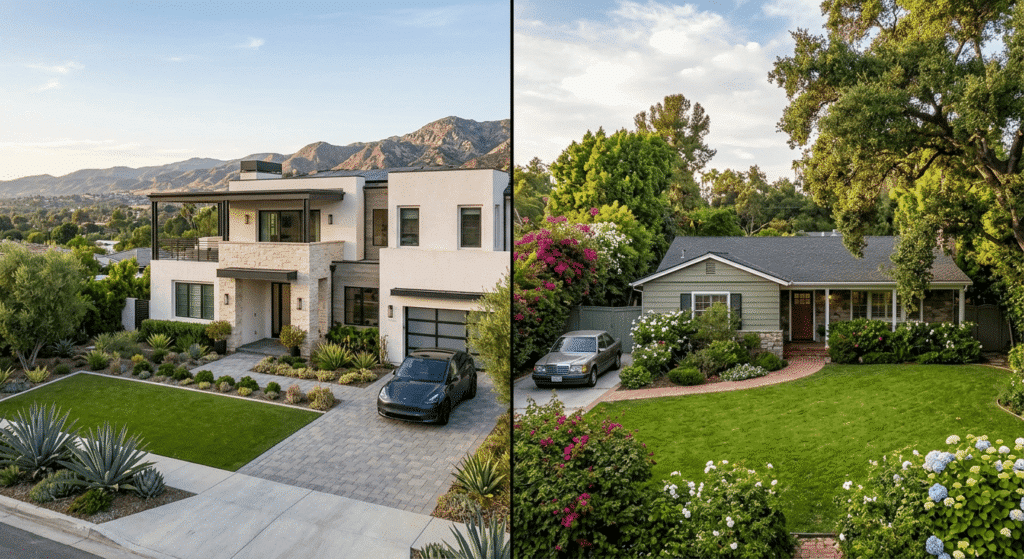
If you’re shopping for a home around $1.4 million in the San Fernando Valley, you may be surprised by how differently that budget can work depending on where you look.
The same $1.4 million can buy a newer home with modern amenities in Porter Ranch, a larger lot in an established North Valley neighborhood, or an older ranch-style home with more land in communities such as Sherman Oaks, Encino, Tarzana, or Woodland Hills.
So, which side of the Valley gives you more for your money?
The answer depends on what you value most.
Are you buying square footage? A larger lot? A shorter commute? Newer construction? Schools? Community amenities? Or a location closer to the Westside?
At this price point, understanding those trade-offs can be just as important as finding the right house.
What Does $1.4 Million Buy in the North Valley?
Let’s start in Porter Ranch and the surrounding North Valley communities.
One misconception is that Porter Ranch is made up entirely of brand-new construction. In reality, the area includes homes from several different eras.
Depending on the neighborhood, a $1.4 million budget may put you in a 1960s, 1970s, 1980s, or 1990s home, or potentially a newer construction community.
That means buyers can encounter very different properties while staying within the same general price range.
In some established Porter Ranch neighborhoods, that budget may provide approximately 2,400 to 3,000 square feet, depending on the specific property, condition, lot, and market.
Newer communities may offer modern systems, updated energy efficiency, contemporary floor plans, and community amenities.
For buyers who prioritize a newer home and a more modern lifestyle, those features can be important.
Don’t Limit Your Search to Porter Ranch
Porter Ranch isn’t the only North Valley community worth considering at this price point.
Buyers searching for Northridge homes, Granada Hills real estate, or Chatsworth properties may find a different combination of space, lot size, age, and location.
Many established neighborhoods throughout these communities include homes built during the 1960s, 1970s, and 1980s.
Some properties offer wider streets, larger lots, mature landscaping, and more traditional floor plans.
Chatsworth can also offer properties with larger lots and an equestrian or semi-rural feel in certain areas.
For buyers who prioritize land and square footage over newer construction or proximity to specific amenities, expanding the search beyond Porter Ranch can create additional options.
What Does $1.4 Million Buy in the South Valley?
Now move farther south toward communities such as Encino, Sherman Oaks, Tarzana, and Studio City, and the equation can change considerably.
At around $1.4 million, buyers may encounter older ranch-style homes with approximately 1,600 to 2,000 square feet, depending on the neighborhood and property.
The trade-off can be more land.
Some properties may feature large, flat lots, mature trees, private pools, established landscaping, and the architectural character associated with older San Fernando Valley homes.
In these neighborhoods, buyers may be paying more for the location and land than for the size or age of the house itself.
That’s an important distinction when comparing properties across the Valley.
Space vs. Location
This is one of the biggest questions buyers should answer before they start touring homes.
Do you want more house, or do you want a more convenient location?
A $1.4 million home in Porter Ranch might offer more interior space and newer finishes.
A similarly priced home farther south might offer less living space but a larger lot and a shorter commute to the Westside.
Neither option is automatically better.
It depends on how you actually live.
If you work in Santa Monica, West LA, Century City, or downtown Los Angeles, commute time may have a major impact on your quality of life.
If you work closer to the North Valley or prioritize a larger home, newer construction, parks, and community amenities, Porter Ranch may fit your priorities differently.
The Commute Is Part of the Cost
A home’s purchase price isn’t the only number worth considering.
Your commute has a cost, too.
For someone traveling regularly from the North Valley to areas such as Century City, Santa Monica, or West LA, traffic can add substantial time to the workday.
On the other hand, buyers living farther south may have easier access to Ventura Boulevard, the canyons, and Westside destinations.
That’s why a home search shouldn’t only compare mortgage payments.
Think about how many hours you’ll spend commuting every week for the next several years.
For some buyers, additional space is worth the drive.
For others, getting those hours back every week is more valuable.
Porter Ranch Offers a Different Lifestyle
One of the major draws of Porter Ranch is the combination of residential communities and newer amenities.
The Vineyards at Porter Ranch provides restaurants, shopping, entertainment, and Whole Foods, while the surrounding area offers parks, trails, and community amenities.
Porter Ranch Community School is also an important consideration for families evaluating the area, although school assignments should always be verified for the specific property address.
For buyers looking for a more suburban environment with newer communities and convenient local amenities, these factors can be part of the appeal.
South Valley Location Can Be the Priority
In communities such as Sherman Oaks, Encino, Tarzana, and Studio City, location can be one of the biggest advantages.
These neighborhoods provide access to Ventura Boulevard, canyon routes, restaurants, shopping, and destinations farther west.
Some buyers may accept an older or smaller home in exchange for that location.
For someone who spends a significant amount of time on the Westside, that trade-off can make a meaningful difference in everyday life.
Don’t Forget the Hidden Costs
The purchase price is only the beginning.
At around $1.4 million, buyers should look carefully at the total cost of ownership.
Depending on the property, that can include:
- Property taxes
- HOA dues
- Mello-Roos or other special assessments
- Homeowners insurance
- Maintenance
- Roof replacement
- Sewer repairs
- Electrical upgrades
- HVAC replacement
- Pool maintenance
- Landscaping
Newer Porter Ranch communities may have HOA dues and, depending on the specific development, additional tax or assessment obligations.
Older South Valley homes may have fewer community fees but potentially more immediate maintenance or renovation needs.
The important thing is to calculate the actual cost of the specific home.
Older Homes Require More Due Diligence
If you’re considering an older Sherman Oaks, Encino, Tarzana, Northridge, Granada Hills, or Chatsworth home, don’t focus only on the kitchen and bathrooms.
Look at the systems behind the walls.
Depending on the property’s age and condition, buyers may need to investigate:
- Electrical systems
- Plumbing
- Sewer lines
- Roof condition
- HVAC
- Foundation
- Windows
- Drainage
- Pool equipment
- Termite or other structural concerns
An attractive remodeled interior doesn’t necessarily mean every major system has been updated.
A thorough inspection and appropriate specialist evaluations can help buyers understand what they’re actually purchasing.
Financing Can Change the Equation
At this price point, financing deserves attention early in the process.
Depending on the buyer’s down payment, loan amount, lender requirements, and current conforming loan limits, a purchase around $1.4 million may involve jumbo financing.
Jumbo loans can have different underwriting requirements, including considerations around reserves, income, debt-to-income ratios, and down payment.
HOA dues and other recurring housing costs can also affect affordability calculations.
Before touring homes, buyers should speak with their lender and understand their actual monthly budget rather than simply looking at the maximum purchase price they appear to qualify for.
Don’t Assume Every Renovation Adds Equal Value
Renovation decisions also look different across the Valley.
An older South Valley home may benefit from an updated kitchen, bathrooms, electrical work, or other improvements.
But that doesn’t mean every expensive renovation will produce an equivalent increase in value.
Over-improving a home for its neighborhood can create a pricing problem.
At this price point, buyers may want a clean, functional, updated home, but they are also comparing what they can get in other parts of the Valley.
Before spending heavily on a renovation, look at comparable sales and understand what buyers are actually paying for in that specific neighborhood.
How Sellers Can Avoid the $1.4 Million Pricing Trap
The same comparison that helps buyers also matters to sellers.
A seller in the South Valley may look at Porter Ranch prices and assume their home should command a similar price per square foot.
But buyers don’t necessarily compare homes that way.
They may be deciding between:
- A larger older home with a big lot
- A smaller home in a more central location
- A newer home in Porter Ranch
- A renovated home in Northridge or Granada Hills
- A home closer to the Westside
If the price pushes a property into direct competition with homes that offer substantially different features, buyers may simply move on to another neighborhood.
That is why pricing should be based on relevant, hyperlocal comparable sales rather than a broad San Fernando Valley average.
Buyers Shouldn’t Mix North and South Valley Comps
One of the most important points when comparing properties is that nearby communities aren’t necessarily interchangeable.
A Porter Ranch property should be compared with relevant Porter Ranch properties.
A Sherman Oaks property should be compared with appropriate Sherman Oaks properties.
The same principle applies to Encino, Tarzana, Woodland Hills, Northridge, Granada Hills, and Chatsworth.
Home values are influenced by much more than square footage.
Lot size, location, condition, construction quality, schools, amenities, neighborhood characteristics, and buyer demand all matter.
Should You Buy the Best House or the Best Location?
At this price point, buyers often face a familiar choice:
Buy the nicest house in an average location, or buy the less updated house in a location you really want?
A dated kitchen can eventually be remodeled.
A bathroom can be updated.
Paint, flooring, landscaping, and other cosmetic features can change.
But you can’t move a property closer to your office, change its neighborhood, or make a long commute disappear.
That doesn’t mean buyers should automatically choose an older home.
It means location should be considered alongside the condition and potential of the property.
What Buyers Should Do Before Making an Offer
If you’re shopping around $1.4 million in the San Fernando Valley, take a little time to define your priorities before you start touring.
Ask yourself:
- How much space do I actually need?
- Is a larger lot important?
- Do I want newer construction?
- How long am I willing to commute?
- Do I want an HOA community?
- What monthly payment feels comfortable?
- How much money can I reserve for repairs?
- Am I comfortable renovating?
- Which amenities matter most to my family?
- Where do I expect to work and spend most of my time?
Then compare homes using the same criteria.
Get the Numbers Before You Fall in Love With the House
Before making an offer, buyers should understand more than the listing price.
Ask your lender to calculate the estimated monthly cost, including the applicable property taxes, HOA dues, insurance, and other known housing expenses.
For older homes, consider potential maintenance and repair costs as part of your overall budget.
For newer communities, make sure you understand HOA and any applicable special tax or assessment obligations.
And don’t forget the commute.
A home that costs less each month isn’t necessarily the better financial fit if it adds hours of driving to your weekly routine.
Should You Waive the Inspection?
A competitive market can create pressure to make an offer more attractive.
But buyers should carefully consider the risks before waiving inspection contingencies, particularly on older homes.
A pre-offer inspection or other appropriate due diligence may help a buyer understand the property’s condition before committing to the purchase.
The exact inspection and contingency strategy should be discussed with your real estate professional and, where appropriate, other qualified professionals.
The Right Choice Depends on Your Life
Imagine two families with the same $1.4 million budget.
One chooses a newer Porter Ranch home with modern finishes, community amenities, and more space, but has a longer commute to the Westside.
Another chooses an older Sherman Oaks home with less interior space, a larger yard, and a shorter commute.
Both can be perfectly reasonable choices.
The mistake isn’t choosing the North Valley or the South Valley.
The mistake is buying without understanding what you’re actually prioritizing.
Watch the Video
Want to see the full North Valley versus South Valley comparison?
Watch the Eat Live Love San Fernando Valley video below as Scott Himmelstein breaks down what approximately $1.4 million can look like in different parts of the San Fernando Valley, including Porter Ranch, Granada Hills, Chatsworth, Northridge, Encino, Sherman Oaks, Tarzana, and Woodland Hills.
The video takes a closer look at space, location, commute, hidden costs, financing, renovation considerations, and the questions buyers should ask before deciding where their budget makes the most sense.
Final Thoughts
A $1.4 million budget can look very different depending on where you shop in the San Fernando Valley.
In Porter Ranch and parts of the North Valley, buyers may find newer construction, larger homes, community amenities, and a more suburban setting.
In the South Valley, the same budget may provide a smaller or older home but potentially a larger lot, mature landscaping, established neighborhood character, and a shorter commute to the Westside.
There isn’t one answer that works for every buyer.
The right choice comes down to your budget, lifestyle, commute, space requirements, tolerance for renovations, and long-term plans.
Before you start touring homes, decide what matters most to you.
Are you buying space, or are you buying location?
Once you know the answer, comparing your options becomes much easier.
Work with Scott